|
 |
![back to [Santiago]](images/menu6.gif) |
![Go to [Nuevo Reino]](images/menu5.gif) |
|
|
|
|
8-REALES PILLAR VARIANTS |
GENERAL DESIGN CONCEPT :
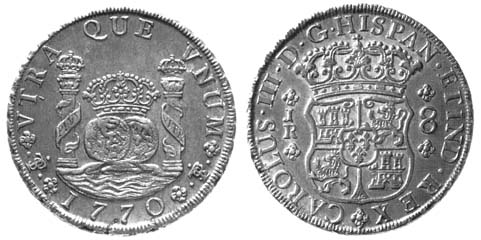
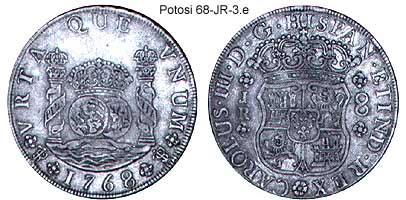
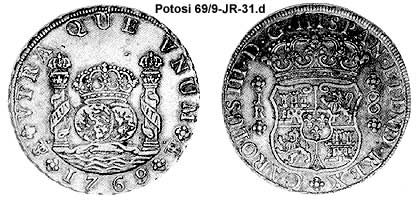
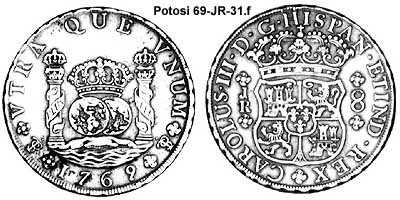
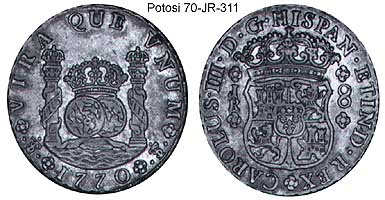
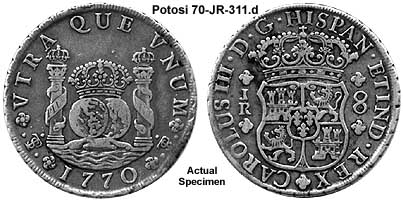
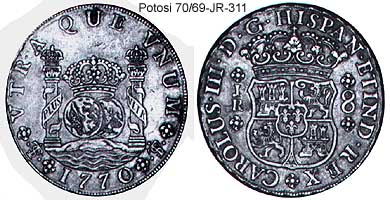
Obverse : Crowned hemispheres between crowned Pillars of Hercules. Inscription VTRAQUE VNUM (Union of two worlds), with mint marks at 4- & 8-o'clock, and year of mintage at the bottom.
Reverse : Crowned quarter arms of Castile and Leon bearing the Bourbon crest in center, "8" to the right and assayer's initial to the left. Inscription [monarch's name]·D·G·HISPAN·ET IND·REX* ([monarch's name], by the grace of God,
King of Spain and the indies/colonies).The mint of Potosi started minting coins in 1574, taking advantage of its huge silver deposits discovered in 1545. Potosi (now part of modern-Bolivia) was one of the main cultural and commercial centers of the Viceroyalty of El Peru. Bolivia or Upper Peru in 1559 was part of the Peru until 1776 when it was transferred to the Vice-Royalty of Rio de la Plata (Argentina). Potosi is the last colonial mint to abandon the macuquina series. It only started striking the Pillars in 1767.
The coins have silver fineness of .916 (11 dineros). Average coin diameter is 37 mm.
| Design Variation Concepts for Potosi Mint | |||
YR/YR-AM-321 |
YR | - the last two digit of the year appearing on the specimen. There are some cases where YR becomes YR/YR, and these are overstrikes. Example are specimen of 1770/69 overstrike. | |
| AM | - the assayer mark which appears on the reverse of the coin | ||
|
3 | -the monarch's name
appearing at the reverse inscription (please note that "1" is fixedly
reserved for PHILIP V's specimens., while "2" is for FERDINAND VI)
|
|
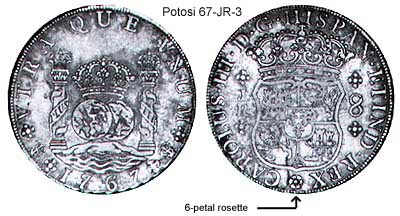
| 2 | On the reverse, the rosette is 6-petal type | ||
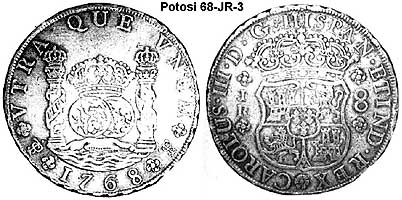
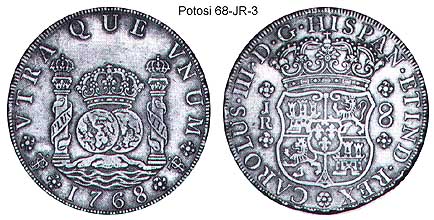
| 1 | On the obverse, there is an additional dot "·" on both sides of the mintmark. | ||
|
|||
SUMMARY OF 8-REALES VARIANTS |
No. of Variants | ||||
| Variation Codes | Assayer | on the reverse, a six-petal rosette at the bottom | presence of dots on the side of the mint mark | confirmed | un- confirmed |
| DEFAULTS: | . | six-petal rosette | no dots on the side of mintmark | ||
| Carlos III | |||||
|
JR | 4 | - | ||
|
JR | four-petal rosette | 5 | - | |
|
JR | four-petal rosette | dot on both side of each mintmark | 3 | - |
TOTAL (3 Major Variations)--> |
11 | - | |||
VARIANTS |
Other No System |
Sample Lot |
Remarks |
|||||
| Elizondo | Calbeto | Patterson | Amat | |||||
|
|
|||||||
| Assayer "JR": Jose de Vargas y Flores and Raimundo de Iturriaga | ||||||||
| 1 | 1229 | - | 4 | KM# 50. Lot 1587 Superior Dec-1998 About 20 to 35 surviving specimens are known to still exist. |
||||
|
|
|||||||
| - | - | 253 | - | Lot 630 Iriarte | ||||
|
3 | 1231 | 255 | 6 | About 75 to 100 surviving specimens are known to still exist. | |||
|
- | - | - | - | d=no dot between "CAROLUS" and "III". Lot 631 Iriarte | |||
|
2 | - | - | 5 | e=error in spelling : "VRTA" instead of "VTRA". About 2 to 5 surviving specimens are known to still exist. | |||
|
- | - | - | - | . | |||
|
- | - | 257 | - | regular or rounded/curved "9" d=no dot between "CAROLUS" and "III". Lot 633 Iriarte. Relatively common variety with about 100+ specimens are known to still exist. |
|||
|
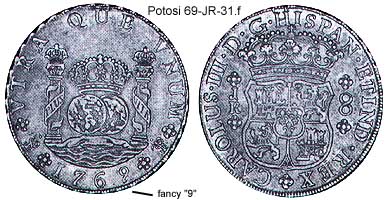
- | - | - | - | 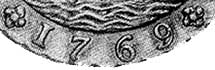 regular
"9" over fancy "9". d=no dot between "CAROLUS" and
"III". see image. Lot 7 FLC
Mar-1982. regular
"9" over fancy "9". d=no dot between "CAROLUS" and
"III". see image. Lot 7 FLC
Mar-1982. About 75 to 100 surviving specimens are known to still exist. |
|||
|
5 | 1235 | 256 | 7 | f=fancy "9". Lot 49 FLC
Nov-1983 Relatively common variety with about 100+ specimens are known to still exist. |
|||
|
|
|||||||
| 6 | 1238 | 262 | 9 | Lot 2 LHRC#43 Relatively very common variety with about 1,000+ specimens are known to still exist. |
||||
|
- | - | - | - | d=No dot between "CAROLUS" and "III". see image | |||
|
- | - | - | 8 | Lot 634 Iriarte About 35 to 50 surviving specimens are known to still exist. |
|||
....
|
|
|
|
Copyright 1998. JTChen (Philippines) and CJara (Chile)
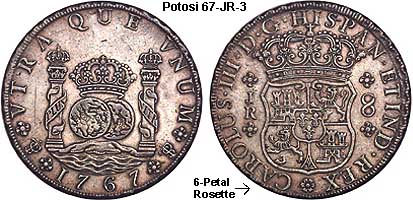
 with 4-petal rosette on both sides; "VTRA QUE" in
two words with "QUE" occupying the top center of the obverse; large main crown
with incomplete lower ellipse; royal crowns on both pillars. There are die variation on
the placement of the tip of the left crown in relation to the inscription
"VTRAQUE", as well as the prominence of the lower ellipse of the main crown.
with 4-petal rosette on both sides; "VTRA QUE" in
two words with "QUE" occupying the top center of the obverse; large main crown
with incomplete lower ellipse; royal crowns on both pillars. There are die variation on
the placement of the tip of the left crown in relation to the inscription
"VTRAQUE", as well as the prominence of the lower ellipse of the main crown.