|
 |
![back to [Mexico]](images/menu6.gif) |
![Go to [Lima]](images/menu5.gif) |
|
|
|
|
8-REALES PILLAR VARIANTS |
GENERAL DESIGN CONCEPT :
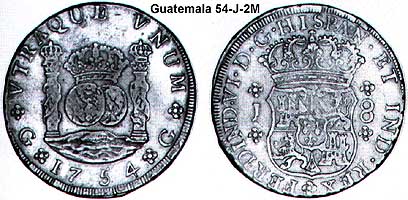
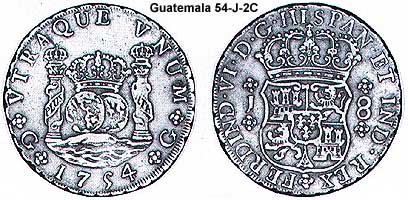
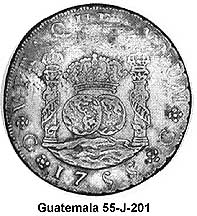
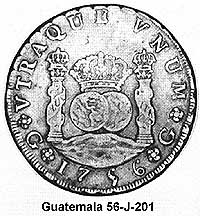
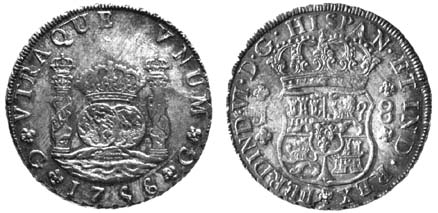
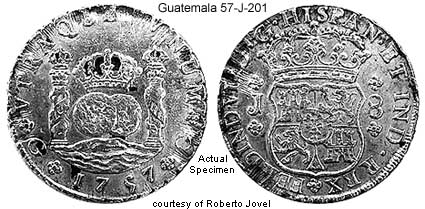
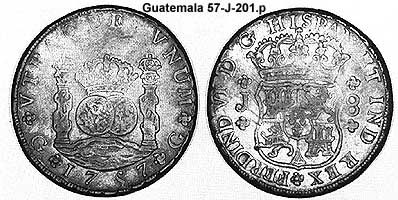
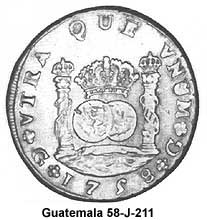
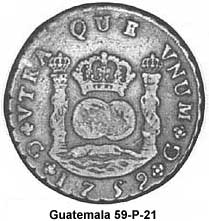
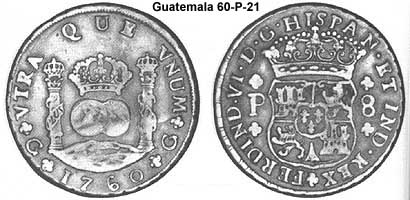
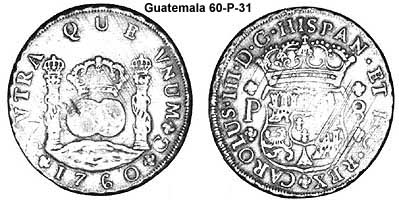
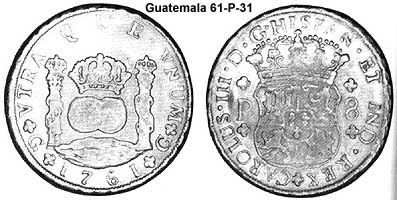
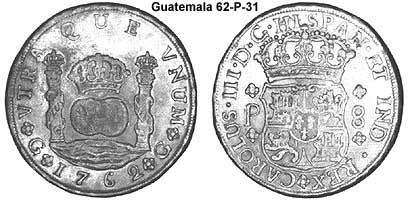
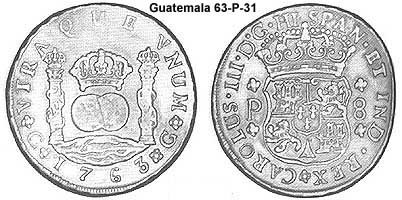
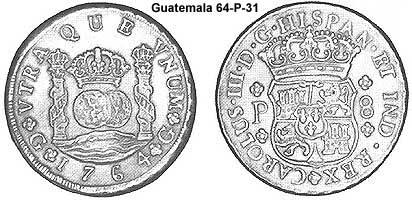
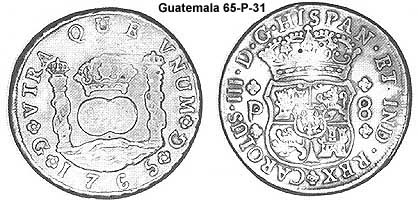
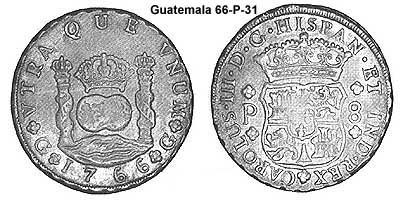
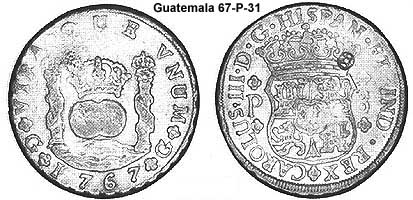
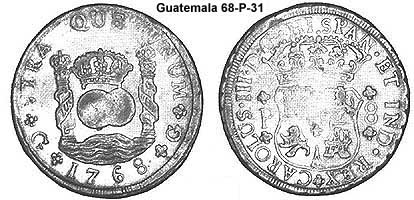
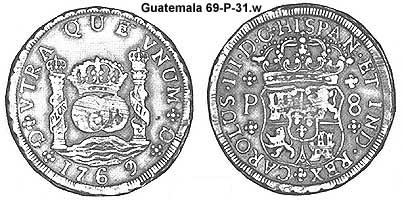
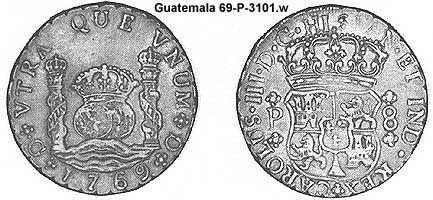
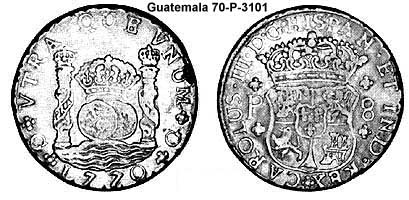
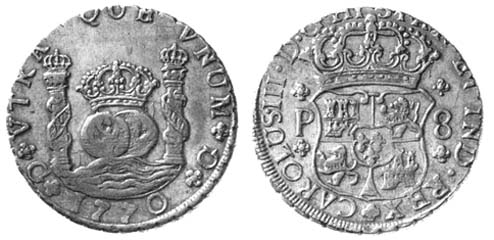
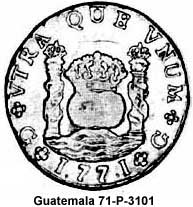
Obverse : Crowned hemispheres between crowned Pillars of Hercules. Inscription VTRAQUE VNUM (Union of two worlds), with mint marks at 4- & 8-o'clock, and year of mintage at the bottom.
Reverse : Crowned quarter arms of Castile and Leon bearing the Bourbon crest in center, "8" to the right and assayer's initial to the left. Inscription [monarch's name]·D·G·HISPAN·ET IND·REX* ([monarch's name], by the grace of God,
King of Spain and the indies/colonies).Guatemala was part of the Vice-Royalty of Nueva España. Although Guatemala Mint adapted the pillar design early, it was minting the design on irregularly cut flans, or macuquinas (cobs). These hammered coins were struck between 1733 to 1753. It was not only until 1754 that the milled coinage were started to be struck..
The coins have silver fineness of .916 (11 dineros). Average coin diameter is 37 mm.
| Design Variation Concepts for Guatemala Mint | |||||
| YR/YR-AM-123M.abc | YR | - the last two digit of the year appearing on the specimen. There are some cases where YR becomes YR/YR, and these are overstrikes. Example are specimen of 1756/5 overstrike. | |||
| AM | - the assayer mark which appears on the reverse of the coin | ||||
|
1 | -the monarch's name
appearing at the reverse inscription (please note that there is NO
"-1" variety, since that number is fixedly reserved for PHILIP V's specimens.
|
|||
| 2 |
|
||||
| 3 | - employed in 1750's varieties to differentiate the use of unimposing "J" versus a bold "J" assayer mark on the reverse of the coin. | ||||
| 4 | - employed starting in 1769 to differentiate the smaller flan variety. | ||||
| M or C | - employed in 1754 varieties to differentiate Modern or Colonial date style | ||||
| .abc | - specifies errors or minor die variations compared to the standard mint design | ||||
|
|||||
VARIANTS |
Other No System |
Sample Lot |
Remarks |
|||||
| Elizondo | Calbeto | Patterson | Amat | |||||
|
|
|||||||
| Assayer "J": Jose de Leon Y Losa | ||||||||
| 1 | 158 | 299 | 155 | KM#18. The number "5" is of
Arabic Type. This is the first year of minting of Pillar for this mint. About 5 to 10 specimens are known to still exist. |
||||
|
2 | 159 | 300 & 302 | 156 | the design of the the year was changed
from Modern- or Arabic to Spanish- or Colonial-type (.C)
[compared with Variant 54-J-2.M] All succeeding years uses the colonial-type number. About 10 to 15 specimens are known to still exist. |
|||
|
- | - | 303 | - | Lot 128 FLC Nov-1981. About 15 to 20 specimens are known to still exist. |
|||
|
|
|||||||
| 3 | 161 | 305 | 157 | About 25 to 35 specimens are known to still exist. | ||||
|
6 | 162 | 309 | 158 | About 75 to 100 specimens are known to still exist. | |||
|
- | - | 308 | - | Lot
193 EOrtiz About 5 to 10 specimens are known to still exist. |
|||
|
- | - | 311 | - | see image About 75 to 100 specimens are known to still exist. | |||
|
7 | 163 | - | 159 | p=reverse marginal inscription is withount the dot punctuation (error die) | |||
|
- | - | 317 | - | . | |||
|
- | - | - | - | s=no obvious spacing between "ET" and "IND" on the reverse marginal inscription. "+" is below the "I" of HISPAN | |||
|
|
|||||||
| 8 | 164 | 313 | 160 | Lot 108 LHRC-43 May-1988 Relatively common with 100+ specimens are known to still exist. |
||||
|
Assayer "P": Pedro Sanchez Guzman | |||||||
10 |
167 |
318 | 161 | (-$$1) is dropped since
assayer mark in consitently bold "P" About 75 to 100 specimens are known to still exist. |
||||
|
11 | 168 | 321 & 322 | 162 | About 25 to 35 specimens are known to still exist. | |||
|
|
|||||||
| 12 | 169 | 358 | 163 | Lot 526 Iriarte About 15 to 20 specimens are known to still exist. |
||||
|
- | - | 359 | - | s0=small "0" relative to variant "60-P-31" | |||
|
13 | 170 | 360 | 164 | Lot 110 LHRC-43 May-1988; Lot 527 Iriarte wider spaced "QUE" About 75 to 100 specimens are known to still exist. |
|||
|
14 | 171 | 363 | 165 | Lot 528 Iriarte Relatively common with 100+ specimens are known to still exist. |
|||
|
15 | 172 | 367 | 166 | Lot 529 Iriarte Relatively common with 100+ specimens are known to still exist. |
|||
|
16 | 173 | 369 | 167 | Lot 530 Iriarte About 25 to 35 specimens are known to still exist. |
|||
|
17 | 174 | - | 168 | modern style "5". About 5 to 10 specimens are known to still exist. |
|||
|
18 | 175 | 371 | 169 | Lot 531 Iriarte About 25 to 35 specimens are known to still exist. |
|||
|
19 | 176 | 374 | 170 | Lot 532 Iriarte About 25 to 35 specimens are known to still exist. |
|||
|
20 | 177 | 377 | 171 | Lot 533 Iriarte Relatively common with more than 250 specimens are known to still exist. |
|||
|
21 var | 179 | 381 | 172 | w=wide. far spaced "9" (large
or standard flan). Lot 534 Iriarte About 15 to 20 specimens are known to still exist. |
|||
|
- | - | 385 | - |
KM# 27.2. normal spaced "9" |
|||
|
21 | 178 | 384 | 173 | far spaced "9" | |||
|
22 | 180 | 386 | 174 | Lot
227 EOrtiz.. ; Lot 535 Iriarte Fairly common with about 100 to 250 specimens are known to still exist. |
|||
|
23 | 182 | 388 | 175 | Lot 536 Iriarte Fairly common with about 100 to 150 specimens are known to still exist. |
|||
....
|
|
|
|
Copyright 1998. JTChen (Philippines) and CJara (Chile)
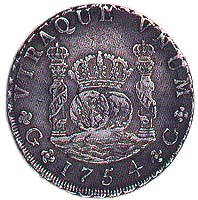
 , "VTRAQUE" as one word; large main crown
has an incomplete lower ellipse; royal crowns on both pillars. There are die variation on
the placement of the tip of the left crown in relation to the inscription
"VTRAQUE", as well as the prominence of the lower ellipse of the main crown. The
year is of Arabic- or Modern- type (-$$[space]$).
, "VTRAQUE" as one word; large main crown
has an incomplete lower ellipse; royal crowns on both pillars. There are die variation on
the placement of the tip of the left crown in relation to the inscription
"VTRAQUE", as well as the prominence of the lower ellipse of the main crown. The
year is of Arabic- or Modern- type (-$$[space]$).